by Adam Merberg on 10 April 2013
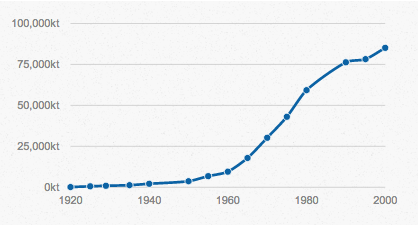
In 1898, the chemist and physicist William Crookes devoted his presidential address to the British Association for the Advancement of Science to “a life and death question for generations to come.” At existing rates, he argued, the world’s wheat crop would cease to be able to feed the world’s wheat-eating people within a few decades. Crookes based his forecast on an estimate of the amount of nitrogen available for the growth of wheat crops. For centuries, farmers had observed that land would become less productive when it was planted year after year. With the advent of modern chemistry, scientists came to understand
by Karl Haro von Mogel on 3 February 2013
The AquAdvantage salmon has captured the attention of the news, politicians, scientists, and activists, and now you have a chance to learn more about it – directly from the people who developed it. AquaBounty Technologies developed the genetically engineered Atlantic salmon by inserting a salmon growth hormone gene with a promoter from ocean pout that causes the salmon to produce growth hormone year-round. This results in a fish that grows to full size in about half the time of wild salmon. For an excellent backgrounder on the AquAdvantage Salmon, see this article by Anastasia Bodnar. AquaBounty Technologies is currently seeking
by Karl Haro von Mogel on 8 January 2013
Years ago, environmental activist and author Mark Lynas campaigned against genetically engineered crops, sometimes ripping them up with his own hands. But in a speech given at the 2013 Oxford Farming Conference on January 3rd, he apologized for these actions, and explained how his opinion has changed over time and has been turned completely around. This speech, the transcript of which you can find on his site, has been heard around the world. It has sparked many discussions in the news media, and in social media as well. He explains that part of his journey from being an anti-GE activist
by Karl Haro von Mogel on 18 September 2012
Back when I lived in California, I bought a 28-gallon fish tank. I always liked keeping fish, but since I have been in Madison, Wisconsin I haven’t found the opportunity to fill the tank up and stock it with the little swimming stress-relievers. Finally, the place for the tank is ready in my basement room, so on Sunday I took a trip to the local aquarium to look for just the right fish for a geneticist to place beneath a subtle neon-on-black painting he bought in Thailand. The answer to that is nothing other than GloFish®, a genetically engineered zebra
by Karl Haro von Mogel on 8 August 2012 I know what you are thinking, but prepare to be surprised. While The Huffington Post has been a joke when it comes to science content on their blogs, there has been some good stuff coming out of their science news section. Our own Kevin Folta has been interviewed for the “Talk Nerdy to Me” series on the Huffington Post Science page. Cara Santa Maria talked to him about genetically engineered crops, and issues related to it. Have a look and watch Genetically Modified Food: ‘The Controversy is Really Curious to Scientists”! “I look at the scientists around me and the
|
|
An Unlikely Fix: nitrogen fertilizer and organic agriculture
In 1898, the chemist and physicist William Crookes devoted his presidential address to the British Association for the Advancement of Science to “a life and death question for generations to come.” At existing rates, he argued, the world’s wheat crop would cease to be able to feed the world’s wheat-eating people within a few decades. Crookes based his forecast on an estimate of the amount of nitrogen available for the growth of wheat crops. For centuries, farmers had observed that land would become less productive when it was planted year after year. With the advent of modern chemistry, scientists came to understand
What do you want to know about AquAdvantage Salmon?
The AquAdvantage salmon has captured the attention of the news, politicians, scientists, and activists, and now you have a chance to learn more about it – directly from the people who developed it. AquaBounty Technologies developed the genetically engineered Atlantic salmon by inserting a salmon growth hormone gene with a promoter from ocean pout that causes the salmon to produce growth hormone year-round. This results in a fish that grows to full size in about half the time of wild salmon. For an excellent backgrounder on the AquAdvantage Salmon, see this article by Anastasia Bodnar. AquaBounty Technologies is currently seeking
Mark Lynas’s Oxford Farming Conference Speech
Years ago, environmental activist and author Mark Lynas campaigned against genetically engineered crops, sometimes ripping them up with his own hands. But in a speech given at the 2013 Oxford Farming Conference on January 3rd, he apologized for these actions, and explained how his opinion has changed over time and has been turned completely around. This speech, the transcript of which you can find on his site, has been heard around the world. It has sparked many discussions in the news media, and in social media as well. He explains that part of his journey from being an anti-GE activist
Are GloFish bad for the environment?
Back when I lived in California, I bought a 28-gallon fish tank. I always liked keeping fish, but since I have been in Madison, Wisconsin I haven’t found the opportunity to fill the tank up and stock it with the little swimming stress-relievers. Finally, the place for the tank is ready in my basement room, so on Sunday I took a trip to the local aquarium to look for just the right fish for a geneticist to place beneath a subtle neon-on-black painting he bought in Thailand. The answer to that is nothing other than GloFish®, a genetically engineered zebra
GMOs on the Huffington Post
I know what you are thinking, but prepare to be surprised. While The Huffington Post has been a joke when it comes to science content on their blogs, there has been some good stuff coming out of their science news section. Our own Kevin Folta has been interviewed for the “Talk Nerdy to Me” series on the Huffington Post Science page. Cara Santa Maria talked to him about genetically engineered crops, and issues related to it. Have a look and watch Genetically Modified Food: ‘The Controversy is Really Curious to Scientists”! “I look at the scientists around me and the