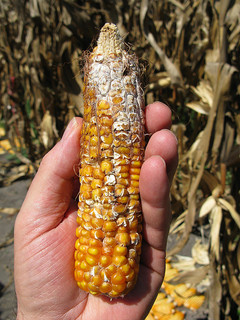
This is a part of the series The Promise of GMOs. Do GMOs live up to the promises of the biotech industry? In the case of reducing dangerous mycotoxins, there is data to back up industry claims.

Producing foods free of toxins such as mycotoxins
BIO’s claim here is that “Biotech is helping to feed the world by: Producing foods free of … toxins such as mycotoxin.”
Verdict: Promise met.
Mycotoxins are produced by some fungi that infect plants, and when consumed they can cause a variety of health problems in humans and other animals. The plants can get infected in the field, and the fungi can multiply if storage conditions are not quite right.
In the US and most other developed countries, we’ve used careful farming and storage methods to greatly reduce mycotoxins in food to the point that most people have never heard of them (although there are still outbreaks, especially in peanut). In the US, mycotoxins are primarily a health concern for livestock.
In Africa, unfortunately, mycotoxins are still a major health problem for humans. The following is paraphrased from a seminar abstract by the London International Development Center:
Africa experiences largely uncontrolled contamination of staple foods by two mycotoxins: aflatoxin and fumonisin. Maize is the main source of both. Peanuts, groundnuts, rice, and dried cassava are also sources of aflatoxin. Mycotoxins have huge hidden health costs. Fumonisin is associated with esophageal cancer, spina-bifida, and infant stunting. Aflatoxin alone contributes to >40% of the burden of disease in developing countries. Aflatoxin promotes liver cancers, suppresses immune systems, interferes with protein and nutrient absorption, and accelerates the progression of HIV and associated opportunistic infections like TB. There is a very strong correlation between HIV transmission and maize consumption that may be due to fumonisin, although more research is needed to prove a cause.
Managing mycotoxins is difficult. Even when food is known to be contaminated, it will get eaten due to food insecurity. Most foods in Africa are traded in informal markets, so regulation is ineffective, and regulation will raise the price of food. Farming methods to reduce myctoxins do exist, but small farmers are unlikely to adopt them without some sort of subsidy. There are at-home food additives that bind the toxins that may be more affordable, but they need to be continuously distributed.
In short, mycotoxins are very bad news in Africa, and it’s a difficult problem to solve. Mycotoxin-producing fungus is worse in foods that have a lot of insect damage: the fungus enters the grain through the bites insects take. A Bt corn reduces insect damage which in turn reduces mycotoxins. A 2010 review of 23 studies of mycotoxins in corn (full text) found that 19 of these studies “came to the conclusion that Bt maize is less contaminated with mycotoxins than the conventional control variety in each case.”
With regard to mycotoxins, the verdict is promise met. However, I think one could argue that this was a pleasant surprise rather than an intended effect of Bt crops, although I’d be interested to see if anyone has evidence that the biotech industry knew in advance that Bt would reduce mycotoxins.



There was even that study in France:
Yeah France–ban that Bt corn…good call…
http://www.agronomy-journal.org/articles/agro/full_html/2010/04/a9192/a9192.html
I guess the precautionary principle is on holiday.
We had an outbreak of molds in corn producing aflatoxins and vomitoxins three years ago. All corn including the GMO smart stack corn were infected with levels that resulted in deep discounts. The only way to control them is to remove the infected crop residue from the surface of the soil or plowing it into the ground for it to decompose.
I grew non-gmo without a problem while the neighbor across the road from me had problems of getting anyone to even take his smart stack corn due to the levels of toxins.
most of the affected corn did not have any insect damage at all. the ears stood upright and got rain water in them along with the mold spores. the amount of toxins was really a function of when the corn plant died and the ears broke over.
It is definitely true that there are risk factors for corn getting infected with mycotoxin producing fungus other than insect damage. Preventing insect damage is just one way to reduce mycotoxin risk. Really the only sure way to prevent mycotoxins that I can think of would be something like RNAi to kill the fungus before it settles in.
Well, in France, it is now quite more complicated. Even Bt maize improve mycotoxins amount in 2005 and 2006. In 2007, without ECB pressure, it was not so clear. Since EU régulation in 2007, the contamination of maize decreased: early sowing and harvest date, irrigation, Ostrinia management with insecticide and climate allowed it.
This paper on the french agriculture academy web site explains why and how.
http://www.academie-agriculture.fr/groupes-de-reflexion/plantes-genetiquement-modifiees
“Les mycotoxines dans les récoltes de céréales… M. Délos, C. Regnault-Roger, P. Joudrier”
We have to translate it to be largely understood, in few months.
A question about Diabrotica management and mycotoxins content in US: do Bt diabrotica maize is also efficient for a mycotoxins reduction?
Water stress at flowering create ear contamination by fumonisins and aflatoxins and Diabrotica damage create water stress.
An usual syllogism would mean diabrotica damage create….
Thanks for you answer
Best
Found this useful article on Bt traits and mycotoxins: http://graincrops.blogspot.com/2013/08/gmos-and-corn-mycotoxins.html